
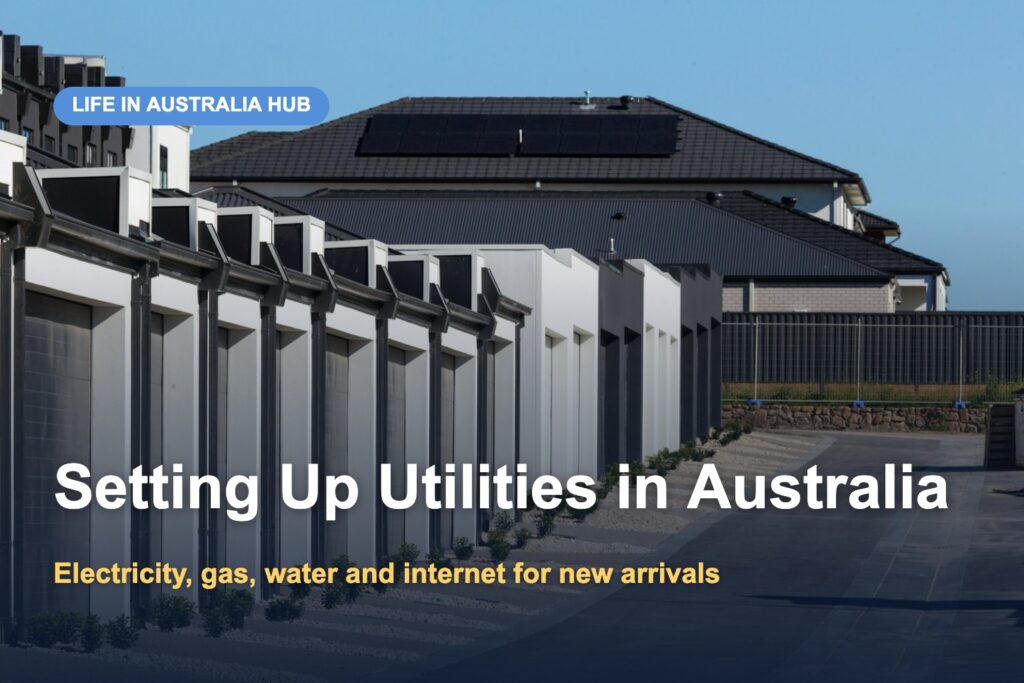
Moving into a new home is exciting, but the first few days can feel messy if the lights, hot water or Wi-Fi are not working. Setting up utilities in Australia is not hard once you know who does what. In most cases you choose your own energy company and internet provider, call or sign up online, and the connection happens within a few business days.
This guide explains how electricity, gas, water and internet work in Australia, who pays for what when you rent, how to compare plans using free government tools, and the common mistakes new arrivals make. It is written for working holiday makers, international students, skilled migrants and anyone moving into their first Australian home.
Quick Summary
| Utility | What you need to know |
|---|---|
| Electricity | You choose a retailer and ask for a “move-in” connection. Most of the east coast has many retailers to choose from. |
| Gas | Not every home has gas. If it does, you set it up the same way as electricity (often with the same company). |
| Water | Usually stays connected. Renters often pay water usage if the home has its own meter; the owner pays fixed service charges. |
| Internet | Most homes use the nbn network. You sign up with an internet provider, not with nbn itself. |
| Compare plans | Energy Made Easy (NSW, Qld, SA, Tas, ACT) or Victorian Energy Compare (Vic). Both are free government tools. |
| Timing | Contact providers at least a few business days before you move in. |
| Problems | Talk to your provider first, then your state energy and water ombudsman or the Telecommunications Industry Ombudsman. |
How Utilities Work in Australia
In many countries one big company supplies your power and you simply pay the bill. Australia is a little different. For electricity and gas, there are usually three groups involved:
- The retailer – the company that sells you energy and sends your bill. This is the company you choose and talk to.
- The distributor – the company that owns the poles, wires and pipes in your area. You do not choose this; it depends on your address.
- The regulator – government bodies that set rules, protect customers and run free comparison websites.
When you move in, you only need to contact a retailer. The retailer then asks the distributor to connect or re-read the meter at your address.
For internet, the main network is the nbn (National Broadband Network). Again, you do not sign up with nbn directly. You choose an internet provider (also called a retail service provider), and that provider arranges your connection.
Who Pays for What When You Rent
If you rent, check your lease before you sign anything. The rules are set by each state and territory, so they are a bit different around the country. Here are two common examples.
New South Wales
In NSW, the landlord must pay the water supply and sewerage service charges. A tenant can only be asked to pay for water usage if all of these apply: the home is separately metered, it meets the water efficiency rules (since 23 March 2025 this includes dual flush toilets with at least a 3-star WELS rating), the charge is not more than the landlord was billed, and the landlord gives the tenant a copy of the bill or other proof. The landlord must ask for payment within 3 months of the bill, and the tenant gets at least 21 days to pay.
Victoria
In Victoria, the rental provider pays to install and connect electricity, gas and the first phone or internet line. If the home has its own meter, the renter usually pays electricity and gas supply and usage costs, and pays for water usage. Renters pay for their ongoing phone and internet usage, and they must ask permission before setting up a new connection (the rental provider cannot refuse without good reason).
Other states
Queensland, South Australia, Western Australia, Tasmania, the ACT and the NT each have their own tenancy rules. The general pattern is similar: tenants usually pay for the energy and water they use, while owners pay for fixed property costs. Always read the “utilities” section of your lease and ask your agent if anything is unclear.
Tip: At move-in, take photos of the electricity, gas and water meters. Write the readings on your condition report. This helps if you are ever charged for usage from before you arrived.
How to Set Up Electricity
Step 1: Find out if you can choose a retailer
In New South Wales, Victoria, south-east Queensland, South Australia and the ACT you can usually choose from many retailers. Tasmania, regional Queensland and the Northern Territory have fewer choices. In Western Australia, most households buy electricity from the state-owned Synergy (Perth and the south-west) or Horizon Power (regional areas), so there is little to compare. Some apartment buildings, retirement villages and caravan parks use an embedded network, where the building owner supplies the power. If your building has one, ask the agent how billing works.
Step 2: Compare plans
Use a free government tool rather than a commercial website that may only show partner companies:
- Energy Made Easy – covers New South Wales, Queensland, South Australia, Tasmania and the ACT. Enter your postcode and some details about your home.
- Victorian Energy Compare – the Victorian Government’s free and independent comparison tool.
Look at the daily supply charge (what you pay every day, even if you use nothing), the usage rate (price per kWh), any time-of-use pricing and whether the price can change. In NSW, south-east Queensland and South Australia, retailers must show how their prices compare to the Default Market Offer, a maximum price set each year by the Australian Energy Regulator for standing offers. In Victoria, the Essential Services Commission sets the Victorian Default Offer. These reference prices make it easier to compare, but they are not always the cheapest option.
Step 3: Sign up and book a move-in connection
Call the retailer or sign up online. You will usually need:
- your full name, date of birth and contact details
- your new address and the date you move in
- an ID document (such as your passport or an Australian driver licence)
- payment details or a bank account for direct debit
Many retailers can connect you within one or two business days if the power is already on at the property, but same-day or urgent connections may cost extra. Book early so you are not left without power on your first night.
Step 4: Check your meter type
More and more homes have a smart meter, which sends readings automatically. Under a national rule, the Australian Energy Market Commission wants every home in the National Electricity Market to have a smart meter by 2030, with an accelerated rollout that started in December 2025. Customers cannot be charged an upfront fee before a smart meter is installed under this program.
A smart meter also matters for the Solar Sharer Offer. From 1 July 2026, eligible households in New South Wales, south-east Queensland and South Australia can opt in through their retailer to get three hours of free electricity in the middle of the day (up to 24 kWh). You need a smart meter, but you do not need rooftop solar. This is a good chance to run the washing machine or dishwasher during the free window.
How to Set Up Gas
First, check whether your home actually uses gas. Look for a gas cooktop, gas hot water system or gas heater. Many newer apartments are all-electric, so you may not need gas at all.
If you do have mains gas, the process is the same as electricity: compare plans, choose a retailer and book a move-in date. Many retailers offer a small discount if you take both electricity and gas from them (a “dual fuel” deal), but always compare the total cost, not just the discount.
Some homes, especially in regional areas, use bottled gas (LPG). In that case you order gas bottles from a supplier. In Victoria, renters pay for bottled gas supply and bottle hire.
How to Set Up Water
Water is usually the easiest. In most rentals it stays connected between tenants, and the bill goes to the owner. The owner or agent then passes on the usage charge to you if the rules allow it (see the renting section above). You normally do not need to call the water company yourself when you rent.
If you buy a home, contact your local water authority to put the account in your name. Water companies are usually owned by the state government or local council, so you cannot shop around for a cheaper water provider.
How to Set Up Internet
Step 1: Check your address on the nbn website
Enter your new address on the nbn “check your address” page. It will show whether the nbn is available and which technology your home uses. There are several types, including fibre to the premises (FTTP), fibre to the node (FTTN), fibre to the curb (FTTC), fibre to the building (FTTB), cable (HFC), fixed wireless and Sky Muster satellite for remote areas.
Step 2: Choose a provider and plan
nbn does not connect you automatically. Contact an internet provider, choose a plan and place your order. Compare:
- Speed tier – faster plans cost more. For one or two people who browse and stream, a mid-range speed is usually enough.
- Contract length – many plans are month-to-month, which is useful if you might move again soon.
- Modem – some providers include a modem; others let you use your own. For FTTN, FTTB and FTTC homes you may need a compatible (VDSL2) modem.
Step 3: Prepare for installation
What happens next depends on your technology. For fibre to the premises and cable, an approved installer may need to visit. For some other types, you can plug in the modem yourself. A standard fibre installation from nbn is free if the outside of the property is not yet connected, but your provider may charge its own fees, so ask before you order.
Other options
If you are only staying for a few months, or you live in a share house where someone else already holds the internet account, a mobile hotspot or 5G home internet plan may be simpler. You just plug in a device, with no technician visit. Check coverage at your address first.
Common Mistakes to Avoid
- Waiting until moving day. Contact your energy and internet providers at least a few business days before you move in.
- Staying on a standing offer. If you never chose a plan, you may be on a more expensive default price. Compare plans once you have a few bills.
- Signing up at the door. Be careful with door-to-door or phone sales. You can always say no and compare first using the free government tools.
- Forgetting to disconnect. When you move out, tell your providers your leaving date so you are not charged for the next tenant’s usage.
- Ignoring bills. If you are struggling to pay, call your retailer early. Energy retailers must offer hardship support, such as payment plans.
What to Do If Something Goes Wrong
Start by calling your provider and asking for a reference number. If you cannot fix the problem with them, you can contact a free, independent ombudsman:
- Energy and water: each state has its own ombudsman, for example the Energy and Water Ombudsman NSW (EWON), the Energy and Water Ombudsman Victoria (EWOV) and the Energy and Water Ombudsman Queensland (EWOQ).
- Phone and internet: the Telecommunications Industry Ombudsman (TIO).
For rental disputes about utility charges, contact your state’s fair trading or consumer affairs office.
Frequently Asked Questions
How long does it take to connect electricity in Australia?
If the power is already connected at the property, many retailers can switch the account into your name within one or two business days. Urgent or same-day requests may cost extra, so contact a retailer as soon as you know your move-in date.
Do I need an Australian credit history to set up utilities?
Not usually. Most energy and internet providers accept new arrivals with a passport and an Australian bank account or card. Some may run a credit check or ask for a security deposit, so ask before you sign up.
Can I choose my own energy company if I rent?
In most cases, yes. If the home has its own meter, you normally open the account in your own name and choose the retailer. The exception is an embedded network (common in some apartment buildings), where the building owner supplies the energy.
Who pays the water bill in a rental?
It depends on the state. In NSW and Victoria, owners pay fixed service charges, and tenants can be asked to pay water usage if the home has its own meter (and in NSW, meets the water efficiency rules). Check your lease.
Is the nbn the only internet option?
No. The nbn covers most homes, but you can also use mobile broadband, 5G home internet or, in some buildings, a private fibre network. Short-term residents often prefer a no-contract mobile or 5G plan.
What is the cheapest way to pay for electricity?
Compare plans on Energy Made Easy or Victorian Energy Compare, choose a plan that fits how you use power, pay on time and use appliances at cheaper times if you have time-of-use pricing. If you are eligible for the Solar Sharer Offer, use it for heavy appliances during the free hours.
Final Thoughts
Setting up utilities in Australia comes down to four simple steps: read your lease, compare plans with the free government tools, sign up a few days before you move in, and record your meter readings. Most new arrivals only need an electricity account, maybe a gas account, and an internet plan.
The founder of Life in Australia Hub has lived in Australia since March 2013, and the best advice for any new home is the same: sort out power and internet early, and review your plans after a few months. Rules and offers change, so always check the official websites before you sign up.
Related Guides
- How to Rent a House or Apartment in Australia
- SIM Card in Australia: Best Phone Plans for Newcomers
- How to Open a Bank Account in Australia
- Cost of Living in Australia
- Best Cities to Live in Australia

