
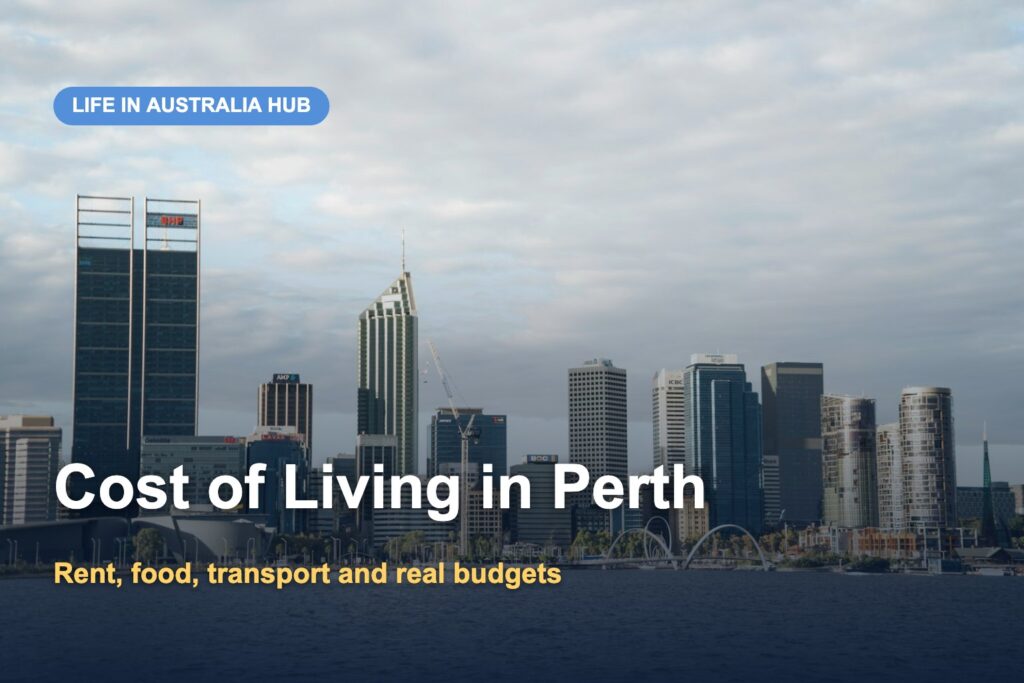
Perth is sunny, close to the beach and a major centre for mining and resources work. It also has some of the cheapest public transport of any big Australian city. But the cost of living in Perth is not as low as many newcomers expect, because rents have climbed past those in Melbourne and Brisbane.
This guide uses the latest figures we could check for rent, groceries, power and transport. We also show the sums, so you can change them to fit your own life. Official and survey figures are named. Sample budgets are our own estimates in Australian dollars.
💡 Want a number for your own situation? Try our free Australia Cost of Living Calculator. Choose Perth, your household and your lifestyle to see an estimated budget in seconds.
Quick Summary
| Living situation | Estimated monthly cost (AUD) |
|---|---|
| Single person sharing a house | $2,300 – $3,200 |
| Single person renting a unit | $3,750 – $4,600 |
| Couple renting a unit | $4,800 – $6,600 |
| Family of four renting a house | $6,400 – $8,300 |
- Biggest cost: rent, with a median of $750 a week for a house and $700 for a unit
- Biggest advantage: a flat train and bus fare of $2.80 with Autoload, and free travel on Sundays
- Main catch: very few empty rentals, so you may need to apply for several homes
How Much Is Rent in Perth?
Domain’s report for the September 2026 quarter puts median weekly asking rents in Perth at $750 for a house and $700 for a unit. The Real Estate Institute of Western Australia (REIWA) reported the same two figures for the same quarter.
| City | House (per week) | Unit (per week) |
|---|---|---|
| Sydney | $835 | $780 |
| Perth | $750 | $700 |
| Brisbane | $700 | $660 |
| Adelaide | $650 | $550 |
| Melbourne | $600 | $600 |
Source: Domain Rental Report, September 2026 quarter. So Perth is cheaper than Sydney, but a typical unit here now costs $100 a week more than in Melbourne. That is about $433 a month.
Finding a home can also be hard. Domain measured a vacancy rate of 0.4% in September 2026, while REIWA reported 1.7%. The two use different methods, but both point to a tight market. Have your documents ready before you inspect, and read our guide to renting in Australia first.
Room in a share house
Sharing is the cheapest way to live in Perth. We looked at Perth listings on Flatmates.com.au in November 2026, and most of the first page asked $280 to $400 a week. More than half of those rooms included bills, so always ask what the price covers. This was a small sample rather than an official median, so treat it as a starting point.
Where rents are higher and lower
| Area | Median weekly rent | Type and period |
|---|---|---|
| Applecross | $875 | Unit, 2025–26 |
| Beckenham | $650 | Unit, 2025–26 |
| Cannington | $750 | House, 2025–26 |
| Rockingham | $630 | House, 3 months to April 2026 |
| Armadale | $615 | House, 3 months to April 2026 |
| Mandurah | $540 | House, 3 months to April 2026 |
Source: REIWA. These are snapshots from different periods, so use them to compare areas and check current listings before you decide.
Example: does a cheaper suburb pay off?
In the three months to April 2026, REIWA put the median house rent at $730 across Greater Perth and $540 in Mandurah. That is a difference of $190 a week, or about $820 a month. The Go Anywhere fare covers the whole trip, so the extra distance adds no extra fare.
The real price is time. The Mandurah line takes about 50 minutes from Mandurah to central Perth, before you count the trip to and from each station. Before you sign a lease, check the door-to-door trip at the time you would really travel.
Your First-Month Costs
Moving in costs far more than an ordinary month. In Western Australia, a landlord can ask for a bond of up to four weeks’ rent (unless the rent is over $1,200 a week) and up to two weeks’ rent in advance. Here is the sum for a unit at the $700 median:
| Item | Cost |
|---|---|
| Bond (4 weeks) | $2,800 |
| Rent in advance (2 weeks) | $1,400 |
| Total before you buy anything | $4,200 |
Then add furniture, kitchen items, a phone plan and connection fees for your bills. For a room in a share house, ask how much the bond and advance rent will be and get the answer in writing. Your bond can be topped up after a rent increase, so keep some savings aside.
There is some protection after you move in. Rent can be raised only once every 12 months, with at least 60 days’ written notice.
Groceries and Eating Out
Finder’s 2026 research puts average weekly grocery spending at $152 for a single person, $200 for a couple and $274 for a couple with children. These are national figures. Across all households, Western Australia had the lowest state average at $164 a week, compared with $207 nationally.
Careful shoppers can spend less than the single-person average, so our budgets use $110 to $152 a week. Cooking at home in a share house, buying supermarket specials and using Asian grocers for staples all help.
Eating out is a matter of choice. As a rough guide, allow about $5 to $7 for a coffee, $15 to $25 for a casual lunch and $30 to $50 per person for dinner at a mid-range restaurant. Prices vary widely by venue.
Public Transport Costs in Perth
Transperth changed its fares on 1 January 2026. The old zones are gone, and one Go Anywhere fare now covers any Transperth service within three hours. Your price depends on how you pay.
| Standard fare | Cash or contactless card | SmartRider | SmartRider with Autoload |
|---|---|---|---|
| Go Anywhere (any distance, 3 hours) | $3.50 | $3.15 | $2.80 |
| 2 Sections (3.2 km or less, one way) | $2.40 | $2.16 | $1.92 |
Daily travel is capped at the DayRider price of $7. Transperth also offers these useful extras:
- Free Sundays: travel is free all day on Sundays with a SmartRider or contactless card, but not on late-night services after midnight on Saturday
- Free CAT buses: these run in central Perth and Joondalup
- Free Transit Zone: trips that start and finish inside the central zone are free, with a card needed on trains
Example: is Autoload worth it?
A commuter who makes 10 full-fare trips a week pays $35 by contactless bank card and $28 with SmartRider Autoload. That saves $7 a week, or about $364 a year. A SmartRider costs $10 and must start with at least $10 on the card, so it pays for itself in under two weeks. Check that your balance is not negative, as that can affect free Sunday travel.
Concession fares are lower, at $1.28 with Autoload, but you must qualify and use a concession card. Do not assume your visa or student status makes you eligible. Check Transperth’s rules first.
Do you need a car?
You can manage without one if you live and work near a train line. Perth is very spread out, though, and many suburbs and work sites are hard to reach by public transport.
Owning a car is a big step up in cost. The RAC’s 2025 survey found that the cheapest small new car to own and run in WA cost about $972 a month, or $224 a week. About $698 of that was loan repayments and about $188 was registration, insurance and compulsory third-party cover. A used car with no loan can cost much less each month, but budget for repairs. See our guide to buying a used car.
Electricity, Water and Other Bills
Most Perth households pay a government-set electricity price called the A1 tariff. From 1 July 2026, it is $1.1924 a day for supply and 33.2621 cents per unit (kWh), so you can work out your own estimate:
| Daily use | Cost per day | About per month |
|---|---|---|
| 10 units | $4.52 | $137 |
| 20 units | $7.84 | $238 |
These sums cover electricity only and use a 30.4-day month. Perth summers are hot and dry, so your use may be higher when the air conditioner is running. Choosing a home with good shade and fans can make a real difference.
In a WA rental, the landlord pays water rates and the tenant pays for water use. For share-house tenants, agree how bills will be split before you move in. Our guide to setting up utilities explains how to connect services, and our SIM card guide compares phone plans.
Sample Monthly Budgets in Perth
These are our own estimates, based on the figures above and a 4.33-week month. Your real costs will differ, so swap in your own numbers.
Single person sharing a house
| Expense | Monthly cost |
|---|---|
| Rent ($300 – $400 a week) | $1,300 – $1,730 |
| Groceries ($110 – $152 a week) | $480 – $660 |
| Public transport (Autoload commute) | $121 |
| Bills share and phone | $100 – $200 |
| Eating out and personal | $300 – $450 |
| Total | About $2,300 – $3,160 |
Single person renting a unit
| Expense | Monthly cost |
|---|---|
| Rent ($600 – $700 a week) | $2,600 – $3,030 |
| Groceries | $480 – $660 |
| Public transport | $121 |
| Power, internet and phone | $250 – $300 |
| Eating out and personal | $300 – $450 |
| Total | About $3,750 – $4,560 |
Couple renting a unit
| Expense | Monthly cost |
|---|---|
| Rent ($700 – $800 a week) | $3,030 – $3,460 |
| Groceries | $700 – $866 |
| Two commutes, or one car and one commute | $242 – $1,090 |
| Bills, internet and phones | $300 – $400 |
| Eating out and personal | $500 – $800 |
| Total | About $4,770 – $6,620 |
Family of four renting a house
| Expense | Monthly cost |
|---|---|
| Rent ($750 – $850 a week) | $3,250 – $3,680 |
| Groceries | $1,000 – $1,190 |
| Car and transport | $972 – $1,400 |
| Bills, internet and phones | $400 – $550 |
| Children and personal | $800 – $1,500 |
| Total | About $6,400 – $8,300 |
Childcare can add a lot to the family budget. Health cover can add to any budget if you are not eligible for Medicare, so read our guide to Medicare and healthcare.
Can You Live in Perth on the Minimum Wage?
If you work for a company, you are usually covered by the national system, where the minimum from 1 July 2026 is $26.44 an hour, or $1,004.90 for a 38-hour week. Your award may set a higher rate. Our guide to the minimum wage in Australia explains the details.
Western Australia also has a State Minimum Wage of $998.30 a week, or $26.27 an hour. It applies only to the state system, which includes workers for many sole traders and unincorporated partnerships. If you are not sure which system covers you, check with the Fair Work Ombudsman or Wageline in WA.
Now compare that wage with rent, using the before-tax national minimum:
- A room at $350 a week is about 35% of the wage
- A unit at the $700 median is about 70% of the wage
So sharing is workable on a single full-time minimum wage, while renting a median unit alone would be very hard. Use our Australian Pay Calculator to see your take-home pay, then compare it with the budgets above.
Common Budgeting Mistakes
- Comparing listings without checking bills. A $350 room with bills can beat a $300 room without them.
- Forgetting the upfront cost. The $4,200 move-in sum above is due before your budget even starts.
- Paying the contactless fare every day. If you commute, Autoload is usually cheaper.
- Choosing a far-away home for the rent alone. If you also need a car, the saving can disappear.
- Assuming Perth is cheap. Its rents are now above Melbourne’s and Brisbane’s, so check today’s figures before you move.
Frequently Asked Questions
How much does it cost to live in Perth per month?
We estimate about $2,300 to $3,200 for a single person sharing a house, and about $3,750 to $4,600 for one person renting a unit. Families should expect much more.
What is the average rent in Perth?
The median asking rent in the September 2026 quarter was $750 a week for a house and $700 for a unit, according to Domain. Rooms in share houses often cost much less.
Is Perth cheaper than Sydney or Melbourne?
Perth is cheaper than Sydney for rent, but it is now dearer than Melbourne. A commuter can also pay much less in Perth, thanks to the $2.80 fare with Autoload and free Sundays.
Is public transport free in Perth on Sundays?
Yes, for Transperth trips with a SmartRider or contactless card. This does not include late-night services after midnight on Saturday.
What is the minimum wage in Perth?
In the national system, which usually covers company employees, the minimum is $26.44 an hour from 1 July 2026. For employees in WA’s state system, the minimum is $26.27 an hour. Casual workers usually get a 25% loading, and awards can set higher rates.
Final Thoughts
Perth can be good value if you share a home, live near a train line and use Autoload. It gets expensive when you rent alone, need a car or have to pay a large move-in sum soon after arriving. Save for those upfront costs first, then test your budget with real listings.
To compare cities, read our guide to the best cities to live in Australia or the national cost of living guide.
Related Guides
- Cost of Living in Australia
- Cost of Living in Melbourne
- Cost of Living in Brisbane
- How to Rent a House or Apartment in Australia
- Minimum Wage in Australia
Official Resources
- Transperth fares
- Household electricity pricing – Government of Western Australia
- Rental bonds – Consumer Protection WA
📋 Free: Your First 2 Weeks in Australia Checklist
New to Australia? Get our printable checklist for your SIM, bank account, TFN, myGov, super, renting and first payslip, plus alerts when visa, wage or tax rules change. No spam, unsubscribe any time.

