
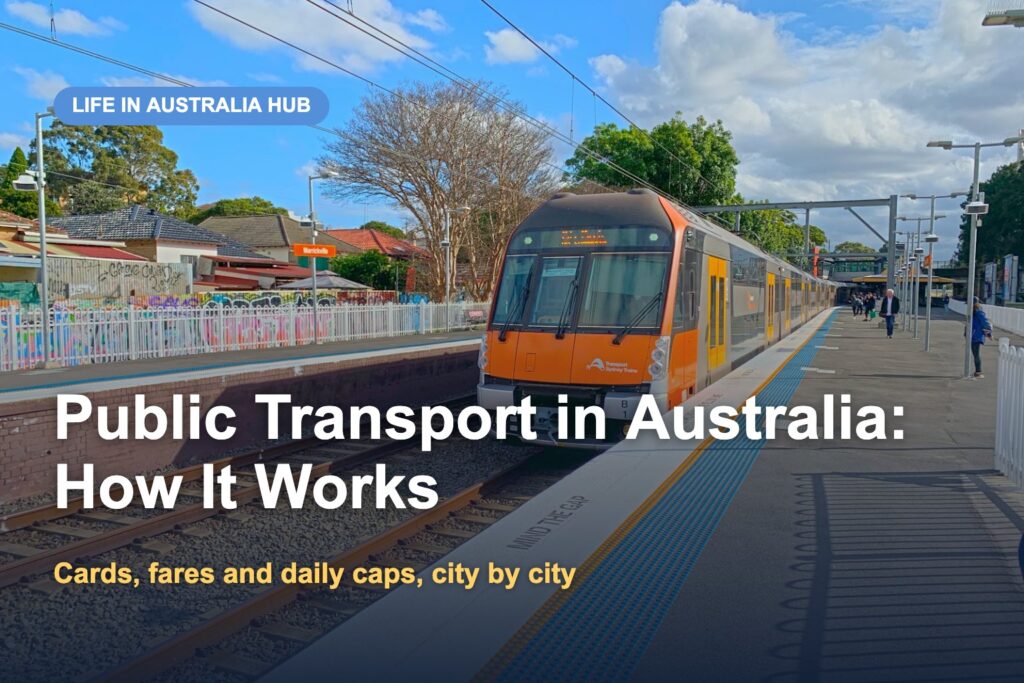
Getting around is one of the first things you need to sort out after you land, and the good news is that public transport in Australia is easier than it looks. Each city runs its own system, with its own card and its own fares, but they all work in a similar way: you tap on, you tap off, and the system works out the price.
In most big cities you no longer need to buy a special card before your first trip. A contactless bank card or a phone wallet often works straight away. Fares and discounts, though, change a lot between states, and some of them are temporary. Below you will find how each system works, what it costs right now, how to pay and the common mistakes that cost newcomers money.
The founder of Life in Australia Hub has lived in Australia since March 2013. All fares here were checked against official transport websites in November 2026, but they can change at short notice, so check the official page before you rely on a price.
Quick Summary
| City | Card | Bank card or phone? | Adult fare (November 2026) |
|---|---|---|---|
| Sydney | Opal | Yes | By distance; capped at $19.30 a day Monday to Thursday, $9.65 Friday to Sunday, $50 a week |
| Melbourne | myki | Yes (Visa, Mastercard) | $2.85 for 2 hours in Zones 1+2; $5.70 a day; $4.00 a day on weekends (half-price until the end of 2026) |
| Brisbane and Queensland | go card (South East Queensland) | Yes, on most services | 50 cents per journey on Translink services |
| Perth | SmartRider | Yes | $2.80 to $3.50 for a trip anywhere; $7 a day; free on Sundays |
| Adelaide | metroCARD | Yes | $4.75 peak or $2.70 off-peak for 2 hours; $12.90 for a Daytrip |
How Public Transport in Australia Works
There is no single national ticket. Public transport is run by each state or territory, so your Sydney Opal card will not work on a Melbourne tram. Within one city, though, the same card or payment method usually covers trains, buses, trams, light rail and ferries.
Tap on and tap off
The basic habit is the same almost everywhere. Hold your card or phone against the reader when you start your trip, and again when you finish. If you forget to tap off, you can be charged a default fare, which in Sydney is the maximum possible fare for your trip. Tap with the same card or device every time, because caps and transfers are tied to that one card.
Smartcard or contactless?
You have two main options in the big cities:
- A city smartcard such as Opal, myki, go card, SmartRider or metroCARD. You add money to it and tap. It is the only way to get some discounts, such as Perth’s cheapest fares.
- Contactless payment with a credit or debit card, phone or smartwatch. There is nothing to set up for adult fares, which makes it ideal for your first days.
If your card is from an overseas bank, check whether your bank adds foreign transaction fees. Many newcomers switch to an Australian card once they have opened a local bank account.
Sydney: Opal Card and Contactless
Sydney’s Opal network covers metro, trains, buses, ferries and light rail. You can pay with an Opal card or tap a contactless card or device. Paper-style single trip tickets also exist, but Transport for NSW says they cost more and do not include Opal benefits, so avoid them if you can.
Fares are based on distance and on when you travel. These rules save you the most money:
- Daily cap: you never pay more than $19.30 a day from Monday to Thursday, or $9.65 on Fridays, weekends and public holidays.
- Weekly cap: $50 from Monday to Sunday.
- Off-peak discount: 30% off metro, train, bus and light rail on Fridays, weekends, public holidays and outside peak times from Monday to Thursday.
- Transfers: changing services within 60 minutes generally counts as one journey.
The Sydney Airport station fee
This one surprises almost everyone. The two airport train stations charge an access fee on top of your train fare. For an adult using Opal or contactless, it is $18.61 per trip, with a separate weekly cap of $37.75. The fee does not count towards your daily or weekly travel caps. If you buy or top up an Opal card at an airport station, a minimum top-up of $35 applies, so tapping a bank card can be simpler on arrival.
Melbourne: myki and Half-Price Fares
Melbourne is the home of the famous tram network, and it now accepts contactless payment as well as myki. You can tap a Visa or Mastercard, a phone or a smartwatch on trains, trams and buses, and contactless fares are the same as myki fares.
Right now, fares are unusually low. The Victorian Government introduced half-price fares from 1 June 2026 until the end of 2026. Under this scheme, the full daily fare dropped from $11.40 to $5.70. Current full fares for metropolitan Melbourne are:
- Zones 1+2: $2.85 for 2 hours, $5.70 a day
- Zone 2 only: $1.80 for 2 hours, $3.60 a day
- Weekend and public holiday cap: $4.00 a day
Treat these prices as temporary and check again from January 2027. The half-price offer also excludes SkyBus, the airport coach, and ferries.
Free and cheaper trips in Melbourne
- Free Tram Zone: trams are free in the CBD and Docklands. You do not need to tap, and if you tap on by accident you can be charged, so leave your card in your pocket.
- Early bird trains: metropolitan train travel is free if you tap on and off before 7am on a weekday, with a 15-minute buffer for tapping off.
- After 6pm: if you tap on after 6pm, your 2-hour fare lasts until 3am the next day.
Getting a myki
You cannot buy or top up a myki on a tram or bus. Buy one at a 7-Eleven in the myki area, a staffed train station, a myki machine or online, and top it up before you travel. Android users can also set up a mobile myki on their phone.
Brisbane and Queensland: 50 Cent Fares
Queensland has one of the simplest deals in the country. Translink fares are a flat 50 cents per journey, however far you travel and however you pay. That covers South East Queensland and regional Translink areas such as Cairns, Townsville and Toowoomba.
In South East Queensland you can use a go card, a contactless card or phone on all trains, trams and ferries and on selected buses, or a pre-purchased paper ticket. In regional Queensland, you buy a paper ticket on board.
One big exception: Airtrain, the private train to Brisbane Airport, is not a Translink service. You can use your go card on it, but you pay Airtrain’s own fare, not 50 cents.
Perth: SmartRider and Free Sundays
Perth simplified its fares on 1 January 2026. A Go Anywhere fare now covers the whole Transperth network of buses, trains and ferries for three hours.
| Fare type | Cash or contactless | SmartRider |
|---|---|---|
| 2 Sections (3.2 km or less) | $2.40 | $1.92 to $2.16 |
| Go Anywhere (3 hours) | $3.50 | $2.80 to $3.15 |
| DayRider (all day) | $7.00 | Capped at $7.00 |
The lowest SmartRider price needs Autoload, which tops up your card automatically. Travel is also free every Sunday for SmartRider and contactless users, though you still need to tag on and off, and it does not cover late-night services after midnight on Saturday. Contactless payments are charged at the standard rate, so concession fares need a SmartRider. Bus drivers no longer handle cash on board.
Adelaide: metroCARD and Tap and Pay
Adelaide Metro raised fares on 1 October 2026. Fares are the same on buses, trains and trams, and each one gives you two hours of travel for any distance.
- metroCARD or Tap and Pay: $4.75 peak, $2.70 off-peak
- Daytrip: $12.90
- 3-Day Visitor Pass: $29.90
- 28-Day Pass: $123.00
Tap and Pay accepts Visa, Mastercard and American Express, but it always charges a regular fare. If you qualify for a concession, use a metroCARD or the Buy & Go app instead. University and tertiary students cannot use a student metroCARD, which is for school students, but they may qualify for a concession fare.
Other Cities and Regional Areas
Canberra uses its own MyWay+ system, while other smaller cities and regional towns run their own bus networks with their own tickets. Timetables are often less frequent, especially at night and on weekends, so check the last service before you head out. If you are moving somewhere regional, you may find you need a car. Our guides to using an overseas driver licence and buying a used car can help.
Can International Students Get Concession Fares?
This is one of the most common questions, and the answer depends on the state. Do not assume your student card gives you a discount, because travelling on a concession fare you are not entitled to can lead to a fine.
- New South Wales: tertiary concessions are generally for Australian citizens and permanent residents. International students qualify only with an Endeavour, Australia Awards or Research Training Program scholarship.
- Queensland: everyone pays 50 cents on Translink services, so tertiary students no longer need to apply for a concession.
- Victoria, Western Australia and South Australia: eligibility depends on your situation. Check the official concession page and ask your institution before you use a concession fare.
In all states, carry your proof of entitlement whenever you use a concession fare.
Common Mistakes to Avoid
- Forgetting to tap off. You can pay a much higher default fare.
- Switching cards during the day. Caps only count on one card or device, so a family or couple needs one card each.
- Tapping on inside a free zone. In Melbourne’s Free Tram Zone, this can cost you a fare.
- Tapping your whole wallet. Take your card out before you tap, so the reader does not pick up the wrong one.
- Assuming a fare applies everywhere. Airport services are often priced separately, as in Sydney and Brisbane.
A free journey planner helps too. Google Maps works well in major cities, and official tools such as the Opal Travel app and the Translink app show fares and service changes.
Frequently Asked Questions
Can I use my credit card on public transport in Australia?
Yes, in the five biggest cities. Sydney, Melbourne, South East Queensland, Perth and Adelaide all accept contactless cards or phones on most services. Regional areas often still need a paper ticket or local card, so check before you travel.
What is the cheapest city for public transport?
For long trips, Queensland’s 50 cent Translink fare is very hard to beat. Perth is free on Sundays, and Melbourne’s half-price fares are very low until the end of 2026. The answer may change in 2027 if Victorian fares go back up.
Do I need an Opal card or myki as a tourist or a new arrival?
No. In Sydney and Melbourne you can simply tap a contactless card or phone for adult fares, and the prices are the same as the smartcard in Melbourne. A smartcard mainly helps if you do not want to use a bank card, or if you need a concession or child fare.
Is public transport free for kids?
In Victoria, people under 18 travel free with a Youth myki. In Sydney, children aged 3 and under travel free and those aged 4 to 15 pay child fares. Other states have their own rules, so check the local website.
What happens if I travel without a valid ticket?
Authorised officers check tickets, and you could receive a fine. If your card or reader fails, tell staff or the operator as soon as you can, and keep any record of your trip.
Final Thoughts
Public transport in Australia is simple once you know the local rules. For your first week, a contactless card is usually all you need. After that, compare it with the local smartcard, especially if you need a concession or want Perth’s lowest fares. Tap on, tap off and keep an eye on those daily caps.
Fares change often, and Melbourne’s half-price offer is due to end with 2026, so always check the official page before you budget. Transport is also only one part of settling in, so see our cost of living guide for the bigger picture.
Related Guides
- Cost of Living in Australia
- How to Rent a House or Apartment in Australia
- SIM Card in Australia: Best Phone Plans for Newcomers
- Setting Up Utilities in Australia
- Student Visa Australia (Subclass 500)

