
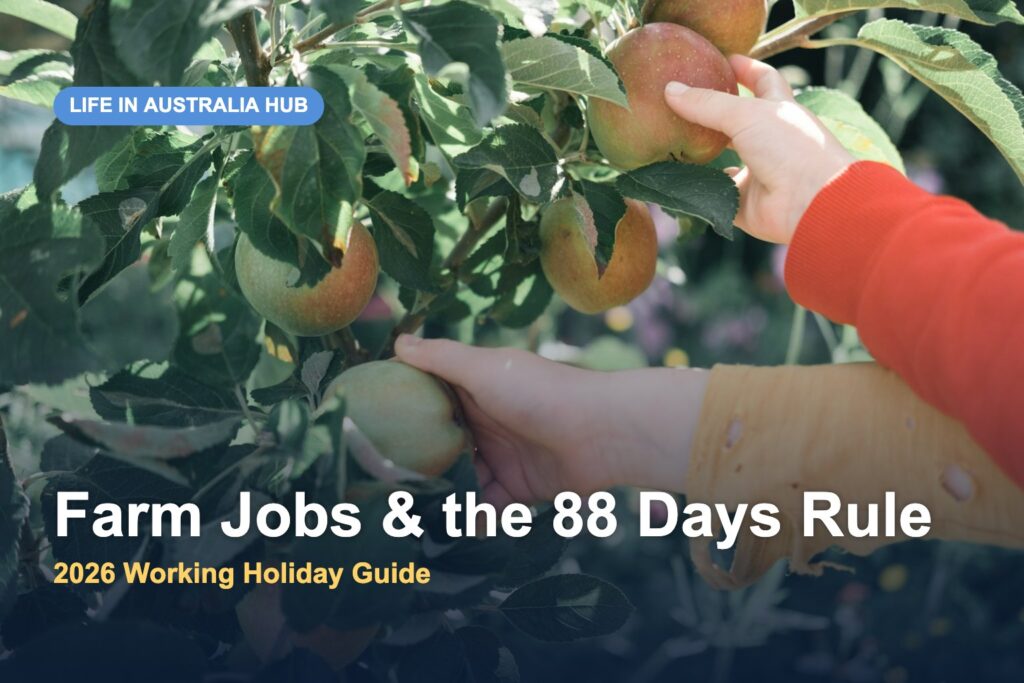
Farm work is one of the most common jobs for working holiday makers in Australia. For many people it is also the key to staying longer, because doing farm work (and other “specified work”) in regional Australia can make you eligible for a second or third Working Holiday visa.
This guide explains how farm jobs in Australia work, what the 88 days rule really means, what counts as specified work, how much you can earn, and how to avoid the problems that catch many backpackers out. These are some of the most common questions working holiday makers ask.
💡 Counting your days? Use our free 88 Days Calculator to add up your specified work, and see Farm Work Seasons in Australia to plan when to go.
Quick Summary
| Question | Answer |
|---|---|
| How many days for a second visa? | 3 months of specified work (88 calendar days) |
| How many days for a third visa? | 6 months of specified work (179 calendar days) |
| Where? | Eligible regional postcodes (and some northern or remote areas for tourism work) |
| Can I split it between employers? | Yes |
| Do UK passport holders need it? | No, for applications lodged on or after 1 July 2024 using a UK passport |
| Minimum pay | Award rates apply. Pieceworkers under the Horticulture Award have a minimum hourly guarantee |
All visa details were checked against the Department of Home Affairs website at the time of writing. Rules can change, so check before you start.
What Is the 88 Days Rule?
If you hold a Working Holiday visa (subclass 417) or Work and Holiday visa (subclass 462), you can apply for a second visa if you complete 3 months of specified work while on your first visa.
Home Affairs defines “3 months” as the three shortest calendar months combined, which is 88 calendar days. Weekends and normal rest days during your employment count toward this period.
For a third visa, you need 6 months of specified work during your second visa. That is 179 calendar days.
It is not just 88 days of work
This is where many people get confused. You must complete the same number of days or shifts that a full-time worker in that job would normally work over 3 months. If you work only two days a week, you will need to work for a longer period to reach the full-time equivalent.
You can meet the requirement by:
- Working full-time (usually 5 days a week) for 3 continuous months
- Working part-time over a longer period
- Combining several shorter jobs that add up to the full-time equivalent
You can spread your specified work across your visa and work for more than one employer. However, you cannot complete the requirement in less than 3 calendar months, even if you work 7 days a week.
What Counts as Specified Work?
Specified work must be in an approved industry and in an eligible area of Australia. For the Working Holiday visa (subclass 417), approved industries include:
- Plant and animal cultivation in regional Australia, such as fruit picking, packing, pruning, harvesting and farm work with animals
- Fishing and pearling in regional Australia
- Tree farming and felling in regional Australia
- Mining in regional Australia
- Construction in regional Australia
- Tourism and hospitality in Northern Australia or Remote and Very Remote Australia
- Bushfire or natural disaster recovery work in declared areas, including some volunteer work
The Work and Holiday visa (subclass 462) has its own list of specified work and areas, so check the 462 rules if that is your visa.
What does not count
Some work related to farming does not count. For example, Home Affairs says secondary processing such as winemaking, brewing, milling and making processed foods is not eligible. General garden maintenance is also not eligible. Always check the official list and the postcode before you accept a job.
Check the postcode
Specified work must be done in an eligible postcode. Home Affairs publishes postcode lists for regional, Northern, and Remote and Very Remote Australia. Many major cities are not eligible for plant and animal cultivation, so a farm close to a capital city may not count.
UK Passport Holders
Since 1 July 2024, UK passport holders can get a second or third Working Holiday visa without doing any specified work, as long as they apply using their UK passport. Many still choose farm work for the income and experience, but it is not a visa requirement for them.
How Much Do Farm Jobs Pay?
Most farm and harvest workers are covered by the Horticulture Award. You can be paid by the hour or by piece rates.
Hourly pay
From 1 July 2026, the Fair Work Ombudsman lists these minimum rates for a Level 1 horticulture employee:
| Employment type | Minimum hourly rate (Level 1) |
|---|---|
| Full-time or part-time | $25.74 |
| Casual (includes 25% casual loading) | $32.18 |
Higher levels and some types of work pay more. Overtime and public holidays can also pay more under the award.
Piece rates
With piece rates, you are paid for how much you pick or pack, for example per bin, bucket or kilogram. Under the Horticulture Award:
- Your employer must give you a written piecework record before you start, showing the piece rate
- Piece rates must allow an average competent worker to earn at least 15% more than the minimum hourly rate
- Since April 2022, pieceworkers must also be paid at least the minimum hourly rate for the hours they work each day, even if they pick slowly
- Group rates are not allowed. Piece rates must be based on your own work
This means you should never earn less than the hourly minimum for the time you work, no matter how fast you pick.
Best Places and Seasons for Farm Work
Harvest seasons move around the country throughout the year. Common regions include:
- Queensland: Bundaberg, the Lockyer Valley, Stanthorpe and Far North Queensland
- New South Wales: the Riverina, Griffith, Leeton, Orange, Young and Coffs Harbour
- Victoria: Mildura, Shepparton and the Yarra Valley
- South Australia: the Riverland and the Barossa
- Tasmania: the Huon Valley and other fruit-growing areas
- Western Australia: Carnarvon, Manjimup and the south-west
The best time depends on the crop. Fruit picking often peaks in summer and autumn, while vegetable work can run for much of the year in some areas. Before you travel, contact employers or labour hire providers in the region to confirm there is work and that the postcode is eligible.
How to Find Farm Work
- Search job websites for “harvest”, “farm hand”, “fruit picker” or “packing shed” with the town name
- Contact local labour hire providers in farming regions
- Check local community noticeboards and Facebook groups, but research the employer first
- Ask at hostels and caravan parks in harvest towns
- Contact farms directly, especially if you have a car
Our guide to the best job websites in Australia lists the main sites to use.
Keep Records: Your Visa Depends on It
When you apply for your second or third visa, you need to prove your specified work. Keep:
- Every payslip
- Your employer’s name, ABN and address, including the work postcode
- The dates and hours you worked
- Bank statements showing your wages
- Any employment verification form or reference your employer provides
Home Affairs says specified work must be paid according to Australian law and awards. Cash jobs with no payslips are risky, because you may not be able to prove the work.
How to Avoid Farm Job Scams and Bad Employers
- Never pay a fee to get a job or to have your days “signed off”
- Be wary of employers who will only pay cash and refuse to give payslips
- Check the employer’s ABN and reviews before you travel
- Ask for the pay rate in writing before you start
- Be careful with accommodation deals tied to the job. Know the weekly cost and conditions first
- Do not accept being told your 88 days will be “signed” without real work. This is visa fraud and can cause serious problems
If you are underpaid or treated unfairly, contact the Fair Work Ombudsman. Its help is free, and visa holders have the same workplace rights as everyone else.
What to Bring for Farm Work
- Sturdy, closed-toe work boots
- A wide-brim hat, sunscreen and sunglasses
- Long-sleeved, light clothing to protect from sun and scratches
- Gloves
- A large water bottle
- Insect repellent
- A car, if possible. Many farms are not reachable by public transport
Frequently Asked Questions
Do I have to work 88 days in a row?
No. You can spread your specified work across your visa and work for different employers, as long as the total equals the full-time equivalent of 3 months.
Do weekends count toward the 88 days?
Weekends and normal rest days during your employment count when you work full-time. If you work part-time, you need to work for longer to reach the equivalent number of full-time days.
Can I do my 88 days in a city?
Usually not for farm work. Plant and animal cultivation must be in an eligible regional postcode. Check the official postcode lists.
Does volunteer work count?
Volunteer work only counts in specific situations, such as recovery work in declared bushfire or natural disaster areas.
How much can I earn picking fruit?
It depends on the crop, season and your speed. Under the Horticulture Award, pieceworkers must be paid at least the minimum hourly rate for the hours they work, and fast pickers can earn more.
Final Thoughts
Farm work can be hard, but it is a great way to see regional Australia, earn money and extend your stay. Make sure the job is in an eligible postcode, that you are paid correctly with payslips, and that you keep good records of every day you work.
For the full visa rules, read our Working Holiday visa guide, and check our guide to the minimum wage in Australia to understand your pay.
Related Guides
- Working Holiday Visa Australia
- Minimum Wage in Australia
- How to Find a Job in Australia
- How to Get a Tax File Number (TFN)
Official Resources
- Specified work for the Working Holiday visa (417) – Department of Home Affairs
- Pay and piece rates in horticulture – Fair Work Ombudsman
📋 Free: Your First 2 Weeks in Australia Checklist
New to Australia? Get our printable checklist for your SIM, bank account, TFN, myGov, super, renting and first payslip, plus alerts when visa, wage or tax rules change. No spam, unsubscribe any time.